Why Ground-Glass Joints Are Everywhere in Organic Labs — And How to Judge One at a Glance
An entry-level guide for students stepping into the organic lab for the first time.

On your first real day in an organic lab, you probably won’t start with NMR or a Schlenk line. You’ll start with something that looks almost boring: putting together a reflux setup.

A round-bottom flask on a heating mantle, a condenser on top, maybe a drying tube or a gas inlet, sometimes a dropping funnel on the side. You line them up on the bench and then—click, click, click—they all press together through those frosted connections.

No rubber stoppers. No tape. No hose clamps holding glass to glass.

The whole apparatus stands there as one piece: heated, sealed, able to run for hours, and still easy to take apart and clean afterward. The quiet hero making this possible is the ground-glass joint.

If you’re going to spend any serious time in an organic lab, learning to “read” a joint with your eyes and your fingertips is almost as important as learning to read a spectrum.


Why ground-glass joints are everywhere in organic labs

Close-up of an organic chemistry distillation setup showing flasks, a condenser and a thermometer connected with standard taper ground-glass joints secured by red Keck clips over a water bath.
In a typical organic lab, almost every connection—from flasks to condensers to thermometers—is made with standard taper ground-glass joints.

If you stop for a moment and look around, you’ll notice something: organic labs are full of standardized glass. Almost every joint you touch will have a marking like 14/20, 19/22, 24/40. Those numbers are not decoration. They are the reason glass from different manufacturers can click into the same setup.

A 24/40 flask from one brand, a 24/40 condenser from another, and a 24/40 adapter someone rescued from the back of a cabinet—if the joints are properly made, they will fit. That standardization is what lets a lab grow piece by piece over years without turning into a pile of incompatible parts.

There is another reason ground-glass joints dominate organic labs: sealing and safety. The frosted surface is not just there to look “lab-like”. When two well-made joints are pressed together:

  • They form a reasonably gas-tight seal, even without grease, good enough for most routine refluxes and many inert-atmosphere experiments.
  • With a thin film of grease and good glass, they can tolerate mild vacuum and long heating periods without the joint creeping open.

Compare that with rubber stoppers. Rubber can swell, crack, or slowly dissolve in strong acids, bases, or organic solvents. A stopper that looks fine at the start of the semester can suddenly become soft, gummy, or leaky halfway through the term. Glass, by contrast, is chemically resistant, heat-tolerant, and dimensionally stable. Once you’ve pressed a good set of joints together, you can mostly stop worrying about the connection and focus on the chemistry.

There is also a very simple, everyday reason: cleanup. Organic reactions leave behind oils, polymers, crystals stuck in corners, and the occasional mysterious brown film. A setup built with ground-glass joints can be taken apart with a gentle twist, piece by piece, and every surface is accessible to brushes, rinses, and the dishwasher or ultrasonic bath. Try doing that with a single flask sealed tightly with a rubber stopper and a glass tube jammed through it—you quickly end up fighting the hardware instead of cleaning it.

All of this adds up to one idea that is easy to forget once you get used to it:
ground-glass joints are what make organic apparatus both modular and trustworthy.


How to judge a ground-glass joint at a glance

Two ground-glass joints shown in close-up: the upper joint has an even frosted surface, while the lower joint shows scratches and shiny worn areas that can leak or seize.

Once you see why they are everywhere, the next step is learning how to tell a good joint from a risky joint just by looking and feeling.

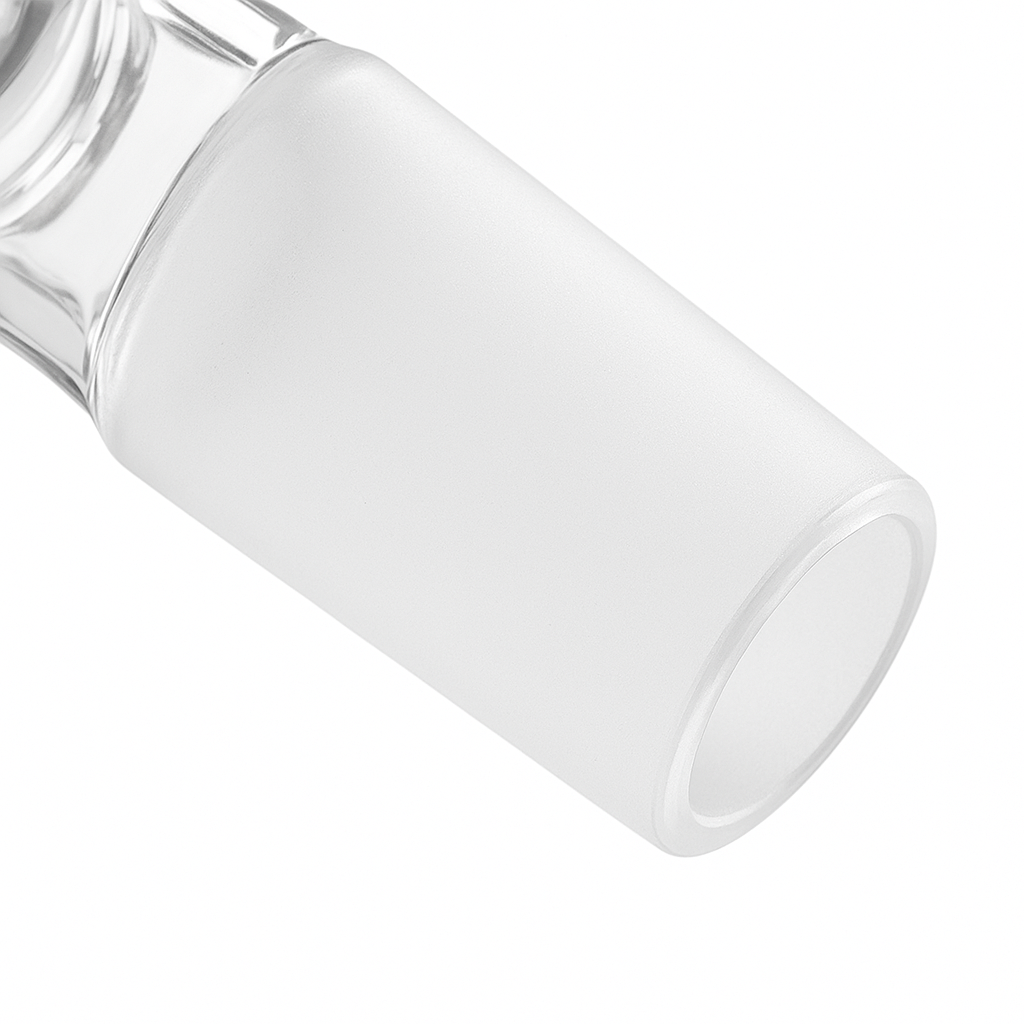
When you pick up a joint, let your eyes go to the frosted zone first. A reliable joint usually has a smooth, even, matte surface. The frosting should be fine and uniform, without deep grooves, bright shiny patches, or obvious pits. If you see a long scratch, a “track” running around the surface, or a polished area where the frost has been worn away, that is a sign the joint has been abused or heavily used. It may still work for a simple, open-to-air setup, but you should hesitate before trusting it on a vacuum line or in a tall, fragile column.

Next, look at the shape of the taper. Hold the joint at eye level and sight along it, as if you were judging whether a glass rod is straight. A well-made joint will have a clean, straight cone: no bulges, no sudden changes in thickness, no “bent waist”. If one end is noticeably thicker, or the taper looks slightly crooked, that mismatch can lead to uneven contact when it is paired with its mate. In mild cases, it just feels awkward. In worse cases, it can concentrate stress and make breakage under vacuum more likely.

After you have looked, you should test it with a real fit. This is where your hands take over from your eyes. Take a matching joint—female to male or male to female—and gently press them together while giving a small twist. You’re looking for a very particular feel:

  • The rotation should be smooth, with no grinding or catching.
  • When seated, the joint should not wobble or rattle if you nudge it.
  • At the same time, it should not seize so tightly that you are afraid to pull it apart.

A good pair of joints will meet, slide, and then “settle” into place. Even without grease, gravity alone should be enough to keep a condenser sitting neatly on top of a flask when the setup is vertical and undisturbed.

On the other side of the spectrum are joints you should treat with caution from the moment you see them. Some warning signs are obvious even from across the bench: chips, cracks, and missing chunks at the rim of the joint. Even small chips at the edge are more than cosmetic. They can create leaks, because the seal is no longer continuous; stress concentrators, where force focuses onto a tiny region; and weak points under vacuum or thermal shock, increasing the risk of sudden failure.

Other warning signs are more subtle: frosting that has become chalky white and rough after years of harsh cleaning, or a joint where parts of the frosted band have turned glassy and shiny. Those bright spots often mean the contact area has been polished away by wear, so less of the surface is actually doing the sealing. For a gentle reflux at atmospheric pressure, you might get away with it. For extended vacuum distillation, it is asking for trouble.

Over time, a simple little ritual can train your hands and eyes to catch problems early.

Quick checklist for judging a ground-glass joint

 Once you start using this checklist as a habit, the whole process becomes almost automatic. You reach into a drawer, your fingers close around a joint, and one quick glance plus a half-turn test tells you if it is a friend or a problem. That quiet, almost unconscious judgment is part of what separates someone who merely uses glassware from someone who really understands it.

When that starts to feel natural, you’re ready for the next step: building complete apparatus from these joints—confidently, safely, and with the calm feeling that the glass is on your side, not working against you.

 Next in the series

If this is your first time really paying attention to ground-glass joints, the next natural question is: how are these joints actually made? That smooth taper and fine frosted surface aren’t born in the furnace – they’re shaped step by step, from forming the glass body to grinding, checking, cleaning, and careful annealing.

In the next article, we’ll walk through that journey from glass tube to finished joint, and show how each stage of the process leaves subtle fingerprints you can see and feel on the final piece.

👉 Read the next article:
How Ground-Glass Joints Are Made — From Blowing and Grinding to Annealing

The Two Worlds of Lab Glass: Why Your Organic Chemistry Lab Doesn’t Just Use Beakers

A student-friendly guide to the “two worlds” of lab glass in organic chemistry. Learn the difference between molded and hand-blown borosilicate glassware, why it matters for heat and vacuum, and how to choose brands that balance safety, performance, and budget.

Most students walk into their first organic chemistry lab and see just glass everywhere.

Look closer, though, and there are actually two worlds of glass sharing the same bench space, each with a completely different purpose and personality.

TL;DR

  • Beakers & cylinders → molded glass, cheap, great for everyday mixing at atmospheric pressure.
  • Condensers, jointed flasks, adapters → hand-blown borosilicate, engineered for heat, cold, vacuum, and complex setups.
  • Using molded glass under heat or vacuum is unsafe. Organic labs rely on hand-blown glass because it’s built for those stresses.

From “Just Glass” to Two Different Worlds

I’ll never forget the first time I walked into an organic chemistry lab. Most students just see “glass everywhere.” But after years of working with it, I see something very different: two distinct worlds sharing the same bench space.

On one side, you have the familiar faces from general chemistry—beakers and graduated cylinders. They’re the reliable, everyday soldiers.

On the other side lies the real magic: long condensers, three-neck round-bottom flasks, distillation heads, vacuum adapters—pieces with standardized joints that click together like scientific Lego.

Here’s the secret most students don’t learn until later:

Those complex pieces aren’t stamped out of molds. They’re hand-blown—born from flame, skill, and careful annealing.

If you remember only three points from this article:

  1. Molded glass is perfect for gentle, everyday work.
  2. Hand-blown borosilicate is designed for heat, cold, vacuum, and modular systems.
  3. Using the wrong glass under stress can cause sudden breakage, solvent sprays, or dangerous implosions.

The Two Personalities of Lab Glass

Think of lab glassware not as different “types,” but as different crafts.

Molded Glass: The Mass-Produced Workhorse

Molded glass is made by pouring molten glass into a metal mold—like baking a cake in a pan.

Common pieces

  • Beakers
  • Graduated cylinders
  • Erlenmeyer flasks
  • Petri dishes
  • Simple storage bottles

Strengths

  • Very inexpensive
  • Durable for everyday mixing, measuring, and storage
  • Easy for teaching labs to stock in large numbers

Weaknesses

  • Walls may be slightly uneven
  • Strength depends on perfect annealing—shortcuts leave hidden stress
  • Cannot form precise standard taper joints
  • Poor performance under vacuum or extreme temperature change

Most importantly, mold cooling creates internal stresses you can’t see—but the glass will certainly “feel” them under heat or vacuum.

Molded glass is perfect for a calm day at atmospheric pressure. Push it beyond that, and it may just let you down.

Hand-Blown Glass: The Artisanal Athlete

Close-up of an Allihn condenser with standard taper joint and clip in an organic chemistry lab
Hand-blown condensers and adapters use standard taper joints so pieces from different sets can click together like a modular system.

This is where the craft begins.

A glassblower starts with a simple borosilicate tube, heating it in a flame to stretch, bend, flare, and shape it. They fuse pieces together and finish with standardized joints (14/20, 19/22, 24/40).

Why it matters

  • Complex shapes are easy. Allihn condensers, multi-neck flasks, cold traps, custom adapters—shapes impossible to mass-produce in molds.
  • Engineered strength. The blower controls wall thickness and reinforces stress points.
  • Proper annealing. The piece is heated and cooled in a kiln to remove internal stress—critical for vacuum safety.
  • Part of a modular system. Every joint is designed to be compatible with global standards.

Yes, hand-blown glass costs more. But you’re paying for precision, safety, and reliability under extreme conditions.

What Organic Labs Actually Do to Glass

Students see “a container.” Experienced chemists see a component in a high-stress system.

1. Thermal Shock

Going from an ice bath to a 200 °C oil bath can shatter poorly annealed or uneven glass. Hand-blown borosilicate expands evenly and can survive these transitions far better.

2. The Crush of Vacuum

Vacuum doesn’t “pull” glass apart—it crushes it inward. Any weak spot—a bubble, thin area, or sharp transition—can fail suddenly.

Damaged round-bottom flask collapsed in an oil bath after vacuum and thermal stress
An example of glassware that failed under combined thermal and vacuum stress—this is why annealing quality and wall thickness control matter.

My golden rule: If I don’t know its history, it never touches my vacuum line. Unknown glass is a silent liability.

3. The Lego Principle

Organic chemistry rarely uses a single piece of glass. You build reflux systems, distillation trains, Schlenk-line assemblies, vacuum filtrations, and multi-step setups.

This only works when every jointed piece from different brands fits and seals consistently. That’s the promise of hand-blown systems.

A Quick Safety Checklist

Before starting your experiment, ask:

  • Heat or extreme cold? → Use hand-blown borosilicate.
  • Vacuum or pressure?Hand-blown only. Never risk “mystery glass.”
  • Visible damage? Star cracks, chips, large bubbles, deep scratches? → Retire immediately.
  • Room-temperature mixing/storage? → Molded beakers or bottles are perfect.

When in doubt, ask yourself: Would I stand in front of it during vacuum or heating? If not, it doesn’t belong in your hood.

Choosing Your Glass Allies: A Practical Brand Guide

Glassblower shaping borosilicate tubing in a flame to make hand-blown laboratory glassware
Hand-blown borosilicate glassware being shaped in flame before annealing. Every joint and contour is crafted with purpose.

Once you move beyond simple beakers and start building complex setups, the brand of glassware you choose becomes a critical decision. It’s not just about budget; it’s about trust. From the assemblies I’ve used and seen in labs around the world, the landscape of hand-blown glass breaks down into three clear tiers.

The Gold Standard: When Failure Is Not an Option

Brands like Chemglass and Wilmad-LabGlass set the benchmark.

Why people choose them

  • Extremely tight dimensional consistency
  • Excellent joints and finishing
  • Strong support for custom apparatus

If your lab runs demanding, high-vacuum or high-temperature experiments every day, this level of craftsmanship earns its price.

The Smart Value Tier: Reliable Performance Without the Premium

Not every teaching lab or startup research group has a research-institute budget. This is where Laboy Glass and similar value-oriented makers fill an important niche.

What they get right

  • True hand-blown borosilicate 3.3
  • Proper standard taper joints
  • Consistent performance for most academic and routine synthetic work
  • Allows departments to equip every bench affordably

This tier offers dependable, safe, and compatible glassware without premium pricing—and that’s why you’ll now find it widely used across universities and teaching labs.

Marketplace Bargains: When Low Price Carries Hidden Risk

The internet is full of ultra-cheap glassware from marketplace-driven brands. Some pieces are usable, but quality and annealing consistency can vary significantly.

For procurement: treat unusually low prices with healthy caution. In organic chemistry, glassware is safety equipment. If you don’t know the annealing history or joint precision, you don’t know whether the glass will behave safely under stress.

The Bottom Line

Organic chemistry doesn’t use hand-blown glass because it looks elegant. It uses it because it’s engineered for the realities of synthetic work—heat, cold, vacuum, modularity, and safety.

Glassware isn’t just something that holds chemicals. It’s a partner you rely on when the experiment gets real.